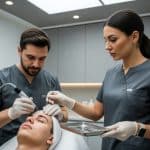
Safety in aesthetics. It might sound like the dull cousin of innovation and artistry, but it’s the foundation that holds the entire field together. Treatments can be transformative, yes, but without prioritising safety, that transformation risks tipping into something far less desirable. And let’s be honest – no one wants their pursuit of beauty to come with unnecessary risks.
When we talk about safety, we’re not only referring to sterile needles and clean clinics (though those matter too – a lot). It’s broader, encompassing training, regulation, ethical practices, and even how practitioners handle unexpected complications. Safety is, essentially, the invisible scaffolding that ensures treatments work as intended and clients feel confident.
We think it’s worth noting that safety isn’t a static checkbox. It’s an ongoing process. Standards evolve, new technologies emerge, and practitioners need to remain sharp. Without a culture that places safety at the centre, the aesthetics industry would risk becoming a bit of a Wild West, where results are unpredictable and clients feel more like test subjects than people seeking care.
Let’s pause here. Imagine booking a treatment you’ve saved for months. You show up, the practitioner seems competent, but halfway through something goes wrong. If that practitioner hasn’t trained to handle complications, the outcome could be devastating. Clients place trust not only in a professional’s skill but also in their judgment and preparedness.
This is why safety is non-negotiable. Aesthetic work, unlike applying makeup or styling hair, often involves medical procedures. Injectables, laser treatments, even some peels – all carry potential risks. Those risks can be managed, but only if the practitioner sees safety as their guiding principle, not an afterthought.
Training is the most obvious yet sometimes underestimated pillar. Anyone can pick up a needle, but not everyone knows how to wield it responsibly. Advanced programmes – such as a Level 7 aesthetics training upgrade – aren’t simply about prestige; they’re about building the competence to perform procedures with confidence and to handle complications should they arise.
But here’s the catch. Training isn’t a one-and-done event. Techniques evolve, regulations shift, and clients’ expectations change. Practitioners who treat their learning as a lifelong journey are the ones who will consistently deliver safe results. This is where the importance of ongoing training for safety comes into play. Continuous professional development ensures practitioners remain aligned with the highest standards rather than relying on outdated knowledge.
Here’s a tricky bit. The aesthetics industry thrives on innovation – new fillers, lasers, sculpting tools, and devices appear every year. The temptation is to adopt the latest technology quickly, to stay competitive. But does innovation automatically equal safety? Not necessarily.
We’d argue the best practitioners are those who balance excitement about new techniques with a healthy dose of scepticism. They research, they test, they verify. In other words, they don’t let novelty outrun safety. Sometimes this means waiting to see how a treatment performs over time before offering it widely. Clients may not always notice the cautious approach, but they’ll certainly notice if things go wrong.

Safety isn’t just about ticking regulatory boxes. It’s a mindset. A practitioner committed to safety doesn’t cut corners – even when no one is watching. They check their supplies, they maintain their equipment, they ensure their space is hygienic, and they double-check medical histories. It’s that extra pause before proceeding that can prevent complications.
And let’s be blunt: some in the industry don’t give safety the weight it deserves. Whether from overconfidence or a desire to maximise profits, safety gets compromised. That’s why clients should always vet practitioners carefully, asking about their qualifications, training, and how they handle complications. Transparency is a hallmark of a safe practice.
When safety is prioritised, the benefits extend beyond individual clients. The industry as a whole gains credibility. Regulators see fewer complaints, insurance companies deal with fewer claims, and the public perception of aesthetics improves. In short, a safe industry is a sustainable one.
There’s also the less tangible but equally important benefit of trust. Clients who feel safe are more likely to return and to recommend their practitioner to others. Trust, once earned, compounds over time. But lose it with one safety lapse, and the damage can be hard to repair.
Some might argue that safety is so fundamental it doesn’t even need to be said. But we think it does. In an industry where appearance is everything, it’s easy for safety to fade into the background while glossy before-and-after photos take centre stage. Yet it’s precisely those behind-the-scenes commitments – sterile environments, thorough training, careful protocols – that make those beautiful results possible.
And while aesthetics can sometimes be framed as purely cosmetic, let’s not forget it deals directly with people’s health. This isn’t trivial. Safety in aesthetics is safety in healthcare, full stop.
If there’s one takeaway, it’s this – true luxury in aesthetics isn’t the plush treatment chair or the sleek packaging of products. It’s the assurance that your wellbeing is protected. Safety should be the foundation on which everything else rests, because without it, even the most advanced treatments lose their value.
So whether you’re a client considering a procedure or a practitioner navigating an evolving industry, remember this: prioritising safety isn’t optional, it’s essential. And in the long run, it’s the very thing that allows beauty and confidence to flourish.