Under-eye treatments are among the most requested procedures in clinics, but they’re also some of the trickiest. Patients arrive hoping for quick fixes for puffiness, fine lines, or tired-looking eyes – yet the margin for error is small. One approach that’s gained traction in recent years is jelly roll botox. Unlike dermal fillers, which add volume, this method relies on muscle relaxation. But is it right for every patient, and how should it be performed safely? Let’s break it down step by step.
The term “jelly roll” refers to the small, sausage-like bulge that appears beneath the lower eyelid when someone smiles or squints. It isn’t always problematic – some cultures even consider it a youthful feature. But for patients who see it as unflattering, jelly roll botox can help.
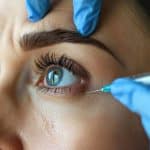
The treatment involves injecting botulinum toxin into the orbicularis oculi muscle, the ring of muscle fibres surrounding the eye. By relaxing this muscle, the under-eye roll softens. Not only is the appearance smoother, but the treatment also helps create a fresher and less fatigued look.
It’s worth noting that this approach doesn’t replace fillers. Fillers add structure and address hollows, while botox reduces dynamic muscle contractions. Mixing the two requires experience, because misjudged combinations can produce stiffness rather than rejuvenation.
This treatment works best in younger patients or those without significant volume loss. If the primary concern is creasing from muscle activity, botox is effective. If, however, there are deeper tear troughs, fillers or alternative treatments will be required.
And timing matters. A patient who only shows jelly rolls when smiling might not benefit in the same way as someone whose rolls persist at rest. The practitioner’s role is to evaluate carefully: is muscle overactivity the cause, or is the issue structural volume loss? The wrong call leads to subpar results.
Still, there are situations where jelly roll botox excels. For example:
In each of these cases, the treatment offers a targeted, conservative option that can be fine-tuned over time.
Technique is everything. The injection must be superficial, targeting only the outer fibres of the orbicularis oculi. Too deep, and the toxin diffuses where it shouldn’t – resulting in asymmetry or, worse, impaired blinking.
Dosing is another balancing act. Typically, very small amounts are used, often just one to two units per side. Overcorrection leads to an unnatural flatness, while undercorrection leaves the bulge unchanged. Not only is precision critical, but so is restraint: less is usually more under the eye.
The patient should be asked to smile during marking so the rolls become visible. Injection points are then placed along the prominent bulge. This ensures accuracy, and it reduces the risk of unintended spread into adjacent areas.

The under-eye region is unforgiving. Even minor errors are obvious. The most common risks include asymmetry, bruising, or eyelid heaviness. In rare cases, patients may experience difficulty closing the eyes fully, which is both uncomfortable and unsafe.
Not only are these complications undesirable, but they also undermine patient trust. A practitioner must set expectations clearly: the outcome is subtle, not transformative. And results are temporary, generally lasting around two to three months. That brevity can actually be reassuring, since it means that if a problem does occur, it won’t last forever.
The other challenge is patient perception. Some may expect the treatment to erase dark circles or hollowness – concerns that botox cannot address. Screening is essential to avoid disappointment. A good consultation saves both patient and practitioner from frustration.
Botox under the eye doesn’t exist in isolation. It’s part of a toolkit that also includes fillers, lasers, skin boosters, and even surgical interventions. Knowing when to combine treatments – and when to avoid combinations – is what defines a skilled practitioner.
And while hands-on expertise comes only with practice, structured learning matters too. For those looking to refine their skills or expand into new areas, it’s worth exploring dedicated training. One route is to explore hands-on beauty qualifications that provide both theoretical grounding and supervised experience.
Arguably, the popularity stems from its balance: minimal downtime, quick administration, and subtle yet noticeable results. Patients can resume normal activities almost immediately, and the effect, while modest, delivers the fresher, more rested look many seek.
There’s also the appeal of accessibility. Unlike invasive surgery, jelly roll botox is affordable and repeatable. Practitioners find it straightforward once they’ve mastered the nuances, making it an easy addition to treatment menus.
But here’s where it shifts: because it looks simple, some underestimate the complexity. In reality, the margin for safe practice is narrower than it appears. That’s why rigorous training and conservative technique remain so important.
Jelly roll botox may be small in scope, but its implications are larger than they seem. Not only is it an effective option for certain under-eye concerns, but it also underscores a broader principle: subtle interventions often carry the most weight in aesthetics.
For practitioners, the challenge is not learning what jelly roll botox is in theory, but understanding precisely when – and how – to use it. With careful patient selection, controlled dosing, and respect for anatomical nuance, the treatment can be both safe and satisfying.
At the end of the day, the under-eye remains one of the most delicate areas in facial aesthetics. And while jelly roll botox is hardly a cure-all, in the right hands, it offers exactly what many patients want: a lighter, less fatigued appearance without dramatic alteration.